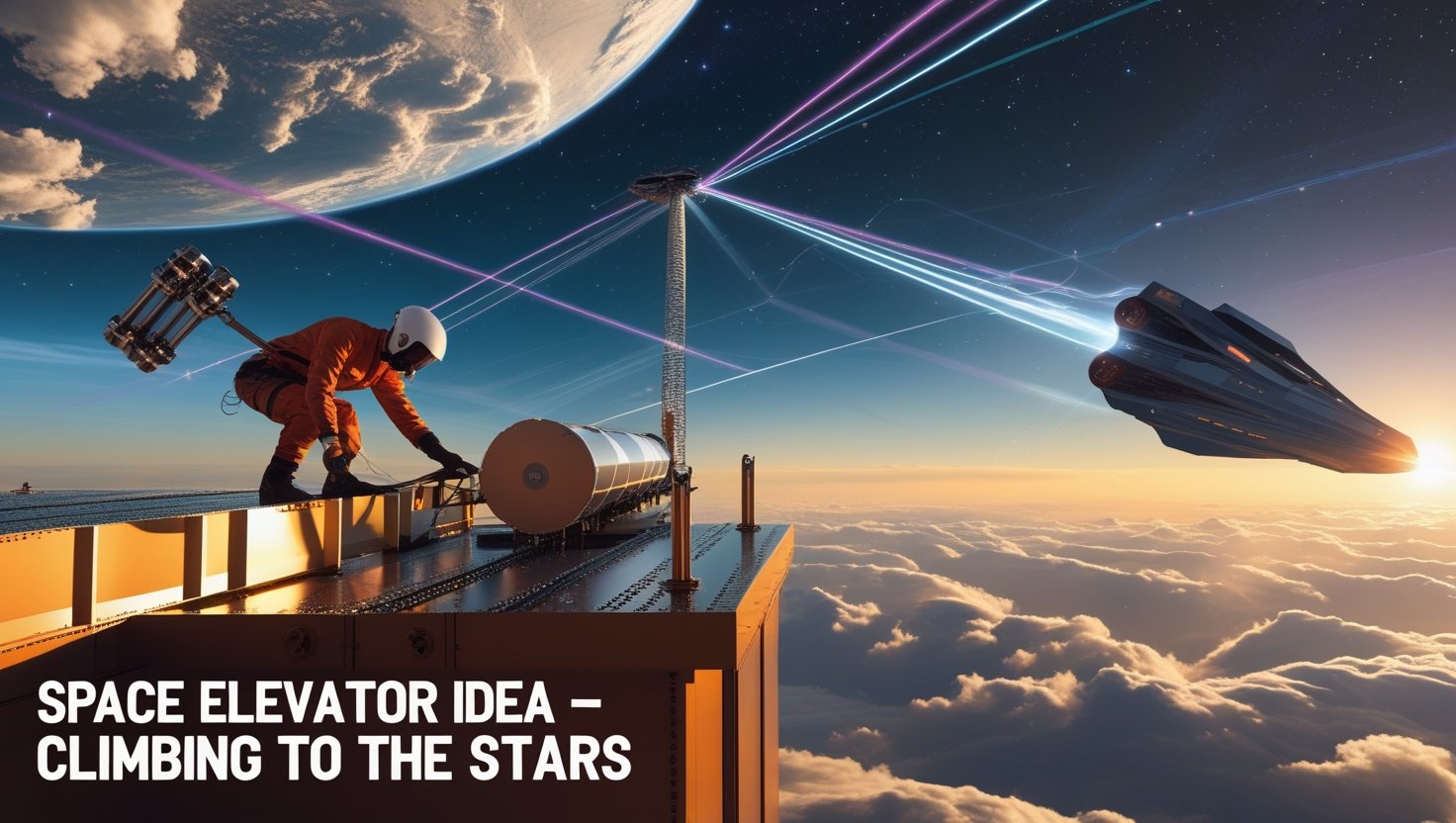
Imagine a future where a slender cable extends from Earth into space, replacing noisy rockets with a silent, smooth ascent. The Space Elevator Idea promises to revolutionize how we approach space travel by making climbing to the stars as simple as taking an elevator ride. This article explores the concept from its visionary roots to the engineering challenges, economic benefits, and collaborative possibilities that could make this dream a reality.
From Vision to Reality:
The space elevator isn’t just science fiction, it’s a bold vision that has fascinated scientists and dreamers for over a century. Originally inspired by monuments like the Eiffel Tower and elaborated by early pioneers such as Konstantin Tsiolkovsky, the idea envisions a tether anchored on the Earth, extending far beyond geostationary orbit. With this anchor, climbers or payload modules could traverse between the ground and space with minimal energy compared to traditional rocket launches.
This futuristic transport system would rely on centrifugal forces and gravity to keep the cable tensioned, allowing objects to “climb” upward steadily. The potential benefits are monumental, including dramatically reduced launch costs, waste minimization, and increased launch frequency. By bypassing the energy-intensive process of launching propellant every time, the Space Elevator Idea could fundamentally alter our approach to accessing space. This fresh perspective invites a generation of engineers and entrepreneurs to reimagine space travel with sustainability and affordability at its core.
Engineering Marvels and Material Breakthroughs:
One of the most daunting obstacles in realizing a space elevator is finding materials strong and light enough to withstand the immense stresses. The tether must endure not only the gravitational pull of Earth but also the relentless tug of centrifugal force as it extends into space. Advanced materials such as carbon nanotubes, graphene composites, and other ultra-high-strength polymers are at the forefront of research. These materials show promise due to their remarkable tensile strength and low density, yet manufacturing them at the required scale remains a significant challenge.
Engineers are pushing the limits of current technology to develop feasible production methods for these materials. Laboratory tests have demonstrated impressive properties, but scaling these innovations to a practical, multi-kilometer cable remains a technical hurdle. Alongside material science, precision in design and construction is crucial. The engineering blueprint must account for environmental extremes, thermal fluctuations, space debris impacts, and even the subtle influences of Earth’s weather systems on the lower sections of the corridor.
Despite these challenges, ongoing research continues to refine both material formulations and construction techniques. Success in these areas would not only validate the Space Elevator Idea but also set a new standard for large-scale, sustainable engineering projects. The drive to overcome these material obstacles is a testament to humanity’s willingness to innovate in our quest to climb to the stars.
Gravity’s Grip: Overcoming Earth’s Pull Efficiently:
At the heart of the space elevator concept is the battle with gravity. Current rocket technology requires enormous amounts of fuel to overcome Earth’s gravitational pull, making space travel costly and environmentally taxing. In contrast, a space elevator leverages mechanical motion powered by external energy, ideally solar, to lift payloads gradually. This method has the potential to reduce energy consumption dramatically by converting what would be a rocket’s explosive thrust into a controlled, continuous ascent.
A key feature of this system is its reliance on counterweights placed beyond geostationary orbit. These counterweights create a balance with Earth’s gravitational force, stabilizing the tether and ensuring that the entire structure remains taut. In practice, this means that the elevator does not actively “fight” gravity but instead uses it as an ally in maintaining equilibrium. The concept also incorporates regenerative braking technology during descent, where kinetic energy can be reclaimed and reused, making the entire operation more energy efficient.
By minimizing the need for onboard rocket fuel, the space elevator offers a significantly eco-friendly alternative to traditional launch mechanisms. This vision of climbing to the stars without the explosive cost of chemical propulsion underscores the ingenuity at the intersection of physics, engineering, and environmental stewardship. As researchers refine the design, the promise of less fuel-intensive and more sustainable space access comes closer to reality.
Economic Horizons:
The economic implications of a functional space elevator extend far beyond lower launch costs. Traditional space missions are notoriously expensive due to the heavy reliance on fuel and the complexities of rocket technology. The Space Elevator Idea presents a radical departure from this model by potentially reducing the cost per kilogram of payload delivered to orbit to a fraction of current prices.
This cost revolution could open up space to a whole new range of commercial and scientific activities. For instance, satellite deployment, space tourism, and even the establishment of space-based manufacturing could become economically viable on a much larger scale. Lower access costs would also foster increased innovation as more players, startups, research institutions, and even international collaborations find it feasible to contribute to space exploration and infrastructure.
Moreover, the stability and predictability of a space elevator offer economic benefits in terms of scheduling and operational maintenance. With Earth-bound elevators operating on controlled energy inputs rather than the uncertainties of rocket launches, logistics become more streamlined. The consequent reduction in risk and maintenance overhead could translate into consistent, reliable access to space. This not only encourages private investment but also has the potential to drive a new era of technological advancement, paving the way for climbing to the stars to become a routine part of our economic landscape.
Risks and Realities:
While the promise of a space elevator is tantalizing, the path to its realization is fraught with risks. Beyond the material and gravitational challenges, there are significant concerns regarding environmental impacts, space debris, and potential hazards during operation. The long, slender cable would traverse a range of atmospheric layers, each with its own set of weather phenomena, from high winds and storms in the troposphere to solar radiation and temperature extremes in the exosphere.
Space debris presents a persistent threat as well. Even a small object colliding with the tether at high speeds could cause catastrophic damage. Proposals to mitigate such risks involve active monitoring systems, tether repair mechanisms, and innovative designs that allow sections of the elevator to be replaced or reinforced as needed. Additionally, ensuring the safety of passengers and cargo during ascent and descent requires rigorous testing of emergency protocols and fail-safe systems.
Political and regulatory factors further complicate the scenario. International collaboration and clear space law are essential to govern such a monumental project, especially as it blurs the traditional boundaries of national airspace and outer space. Despite these hurdles, the potential benefits drive continued research and development. Each technical challenge overcome brings us one step closer to transforming the Space Elevator Idea into a sustainable pillar of future space travel.
The Future of Climbing to the Stars:
The realization of a space elevator would mark one of the most significant achievements in human engineering and a transformative leap toward climbing to the stars. Achieving this goal requires not only breakthroughs in technology and materials but also a unified global effort. International partnerships could provide the necessary funding, expertise, and regulatory frameworks to push the project beyond the realm of theoretical research into practical application.
In this visionary future, space elevators might serve as hubs for broader space exploration initiatives, facilitating everything from low-cost satellite launches to ambitious missions aimed at colonizing other celestial bodies. The structure could also spur new industries, such as space-based solar power generation and orbital manufacturing, creating a ripple effect that benefits technology, economy, and the environment.
Community engagement plays a vital role in this process, as public interest and support are essential for securing the investments required for such an enormous undertaking. As awareness of the Space Elevator Idea grows, so does the collective desire to explore and innovate. Educational initiatives, public-private partnerships, and international research consortia can all contribute to ushering in an era where space travel becomes as routine as catching an elevator in a skyscraper. This collaborative spirit not only fuels progress but also symbolizes humanity’s unyielding quest to reach ever-higher.
Conclusion:
The promise of the Space Elevator Idea lies in its potential to transform how we access space by replacing fuel-hungry rockets with a sustainable, efficient ascent mechanism. By tackling material limitations, overcoming Earth’s gravitational pull, and fostering global collaboration, we stand on the cusp of a new era in space travel, one in which climbing to the stars is an achievable, cost-effective reality. The journey ahead is filled with challenges, but the rewards of innovation and exploration make every hurdle worth surpassing.
FAQs:
Q1: What is the Space Elevator Idea?
It’s a concept for a tethered structure enabling access to space without rockets.
Q2: How does a space elevator work?
It uses a cable anchored to Earth (or the Moon) extending into space, balanced by centrifugal force.
Q3: What materials are needed for a space elevator?
Ultra-strong, lightweight materials like carbon nanotubes or graphene composites are key.
Q4: How can a space elevator reduce space travel costs?
By dramatically lowering the energy and fuel needed to lift payloads into orbit.
Q5: What are the major challenges of building one?
Overcoming gravitational forces, ensuring material strength, and mitigating environmental hazards.
Q6: Could a space elevator boost global space exploration?
Yes, it has the potential to open up low-cost, routine access to space for many activities.
